Communicating Jesus' Way by Charles H. Kraft
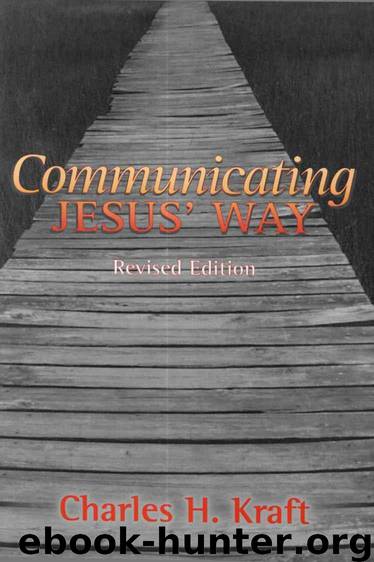
Author:Charles H. Kraft
Language: eng
Format: mobi, epub
Tags: Communication, Religious Aspects, General, Religion, Christian Education, Christology, Christianity, Christian Theology
ISBN: 9780878087730
Publisher: William Carey Library
Published: 1999-01-01T22:00:00+00:00
Chapter Five
How Does Meaning Happen?
How to explain the way(s) in which humans arrive at meaning is a problem that has challenged philosophers, language specialists and just about anyone else who thinks deeply from time immemorial. Lately, a relatively new discipline called communication theory, communication science or communicology has drawn from several academic streams to provide some promising insights into the problem.
In the preceding chapters, various statements have been made concerning meaning that presupposed the position taken in this chapter. Here we will discuss that position in greater detail. It will soon become evident that if this understanding of meaning is taken seriously by Christian communicators, the shape of our approach to communication in the churches will have to be drastically changed.
Traditional Theories of Meaning?
People often assume that figuring out what things mean is fairly easy. You just look or listen and the meaning of what you are seeing or hearing usually comes automatically. Some things have to be worked out. But most of the time the meanings just come naturally.
Such thinking has led to one or the other of two simplistic understandings of how meaning comes to us:
1. The first assumes that meaning is either self-evident or readily available to those who analyze the objects and events of life. Somehow meaning is inherent in the things we see and hear and is given out to people as they experience and/or analyze these things. There is, these people assume, one correct meaning to mountains, accidents and all other elements of life that those who reflect a bit will come to unless their ability to observe and interpret is faulty.
This position is akin to the belief that objective reality is clearly visible to and easily interpretable by all. And my understanding of it is the correct one. If one disagrees with my interpretation of reality, therefore, he/she is wrong. The way I, or my group, sees God, the Bible, the world, politics, child rearing and the multitude of other things in life is considered absolute. This is truth and I have the right to be dogmatic about it. All other views are simply wrong.
Arguments against this theory point out that if the phenomena and events of life contained their own meanings, it would be possible for anyone in any society to uncover the same meaning. This does not seem to happen, however, even for people of different backgrounds within the same society. Though there seem to be similar broad general guidelines for classification of reality to which most of the peoples of the world adhere (rocks and people, for example, are seldom regarded as basically similar), the more impressive fact is that people interpret according to the cultural patterns of their group. And such interpretations and the patterns on which they are based differ, sometimes widely, from group to group.
Even within American society, for example, the meaning attributed to a landscape, a sunset, or a flower is not always the same. Native participants in many societies, though, consider it strange that an
Download
This site does not store any files on its server. We only index and link to content provided by other sites. Please contact the content providers to delete copyright contents if any and email us, we'll remove relevant links or contents immediately.
Professional Troublemaker by Luvvie Ajayi Jones(29641)
Empire of the Sikhs by Patwant Singh(23057)
Twilight of the Idols With the Antichrist and Ecce Homo by Friedrich Nietzsche(18599)
Plagued by Fire by Paul Hendrickson(17391)
The Sun and Her Flowers by Rupi Kaur(14490)
Norse Mythology by Gaiman Neil(13312)
A Journey Through Charms and Defence Against the Dark Arts (Harry Potter: A Journey Throughâ¦) by Pottermore Publishing(9260)
Fangirl by Rainbow Rowell(9210)
Adultolescence by Gabbie Hanna(8900)
Wonder by R.J. Palacio(8548)
Tools of Titans by Timothy Ferriss(8345)
Becoming Supernatural by Dr. Joe Dispenza(8184)
How to Bang a Billionaire by Alexis Hall(8126)
Wonder by R. J. Palacio(8084)
Crystal Healing for Women by Mariah K. Lyons(7908)
The Road Less Traveled by M. Scott Peck(7574)
The Lost Art of Listening by Michael P. Nichols(7475)
The Witchcraft of Salem Village by Shirley Jackson(7240)
The Institute by Stephen King(7014)
